Android Auto (C-233/23): Beyond stating the obvious?

The judgment of the Court of Justice of the European Union (CJEU) in Case C‑233/23 Alphabet and Google v AGCM (Android Auto) (the ‘Judgment’) may seem like the only possible outcome in light of recent case law on Articles 101 and 102 of the Treaty on the Functioning of the European Union (TFEU), as had already been anticipated by Advocate General Medina in her elegant opinion (the ‘Opinion’—discussed in a previous post).
Dear Santa, I’d like to ask a consistent framework for Article 102 TFEU

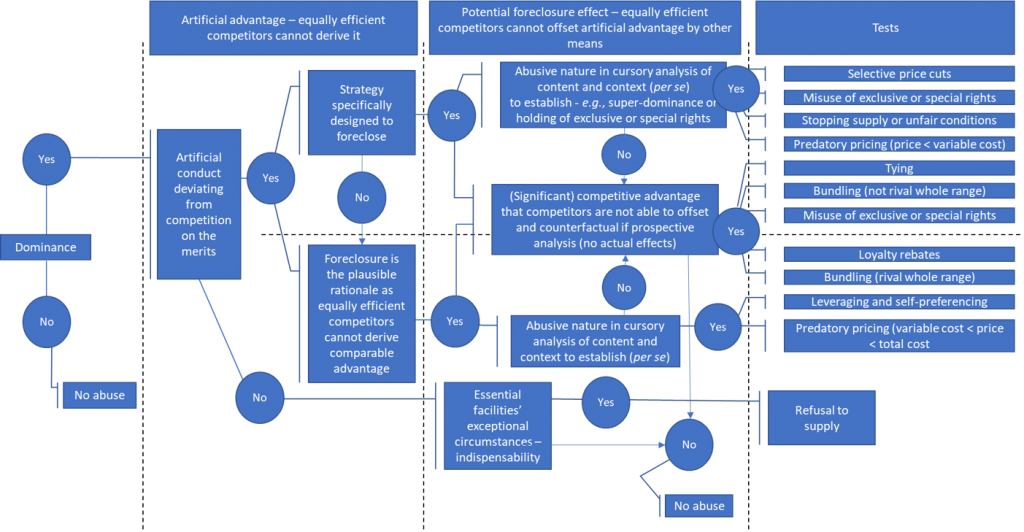
On 31 October, a couple of months before Christmas, I had already sent my Santa letter to the European Commission in response to the public consultation on the Draft Communication from the Commission—Guidelines on the application of Article 102 of the Treaty on the Functioning of the European Union to abusive exclusionary conduct by dominant undertakings (Draft Guidelines)—see full version below.
NEW PAPER! Quantum antitrust – A unified exclusionary abuse theory
Extra! Extra!
Obligations for digital platforms below dominance are no longer virtual reality

The Bundeskartellamt (case B6-55/20) has looked into Meta combining data from different services without the free consent required by Regulation 2016/679 (the General Data Protection Regulation, GDPR) and Meta has buried the axe in the wake of Regulation 2022/1925 (the Digital Markets Act, DMA) and its national replicants (like pioneering and bespoke Section 19a of the German competition act).
What else can we dispense with after indispensability became dispensable? The Spanish competition authority gives a shot at the Slovak Telekom tongue twister

Last 10 June, the Spanish competition authority (Comisión Nacional de los Mercados y la Competencia or “CNMC”) served an interesting decision on a solar power plant developer, together with an EUR 4.9 million fine, for abusing its alleged dominant position as single point of contact with the transmission system operator for access and connection to the electricity grid.
Chips ahoy! Did the more economic unification finally board the per se flagship in Intel III?

Initial thoughts.
General Court in Google Search (Shopping). Chronicle of a renunciation foretold
Is so much of a stir justified?
Digital platforms and blockchain – is the same abuse of dominance bottle good for so different wines?

The features of so-called “digital platforms” have grabbed the headlines of competition law specialised publications for the last years: (i) easy internalisation of positive externalities generated by a user group on one side of the platform though their selling to a group on the other side; (ii) reduced transaction costs – which further increase the ability to channel positive externalities between platform sides; (iii) the exacerbated intensity of increasing returns to scale because of minimal marginal costs; or (iv) the greater value of data thanks to developments in storing and analysis technology.
The Android of dawn

Last July the Commission struck back on Google with record fines, just like in summer 2017. On this occasion, Mountain View’s famous replicant was targeted by Berlaymont’s blade runner to cut short excessive optimism about Intel’s new dawn[1].
Google Search. Shopping for an appropriate abuse standard

Now that Google and the Commission are at daggers drawn in Luxembourg over the 27 June decision in Google Search,[1] it seems like high time to make our educated guesses about how the recently disclosed arguments in the tech giant’s September appeal[2] will come into play.